
Exploring the Lenoir Family Papers
The Special Collections Research Center is pleased to announce that the Lenoir family papers (AC-990) opened to the public on June 24, 2026. Spanning the years 1763 through 2017, the collection boasts over 1,300 documents of Lenoir family history starting with the patriarch, General William Lenoir. According to NCpedia, General Lenoir “was a Revolutionary War officer, justice of the peace, state legislator, and planter-entrepreneur.” The collection includes correspondence, financial records, property documents, photographs, journals, notebooks, newspaper clippings, and personal papers. It is the second largest holdings of Lenoir family materials after the University of North Carolina at Chapel Hill’s Special Collections. Duke University and the University of Tennessee Knoxville also have related collections.
There are many important stories waiting to be uncovered in this collection starting with tales of General Lenoir’s educational and professional life told through letters, court documents, teaching recommendations, and survey sketches. The history of early land ownership in western North Carolina is a large component of this collection, including maps, deeds of ownership, and contractual agreements between the Lenoir family and their tenants. There is also a fascinating handful of documents about Linville and the sale of Grandfather Mountain. Items from and about people enslaved by members of the Lenoir family are a highlight of the collection. There is correspondence from Andy Lenoir and Henry Uriah Lenoir, two enslaved individuals who lived at the family home, Fort Defiance. There is also William Lenoir’s memorandum book that records the names of enslaved individuals along with their birth and death dates or dates when they were sold.
The collection is the product of decades of work by two local Lenoir descendents, Allen Lenoir Poe, a genealogist from Caldwell County, and Isaac “Ike” Forester, a retired CPA from Wilkes County. Forester is the great-great-great-great-grandson of General Lenoir. After Poe’s death in 2006 at age 79, Forester retrieved the collection from Poe’s home in downtown Lenoir. Forester spent 18 years organizing, labeling, transcribing, and adding to this collection. He became a keeper of his family’s history, gaining and sharing his knowledge and appreciation of their legacy while also maintaining a critical lens.
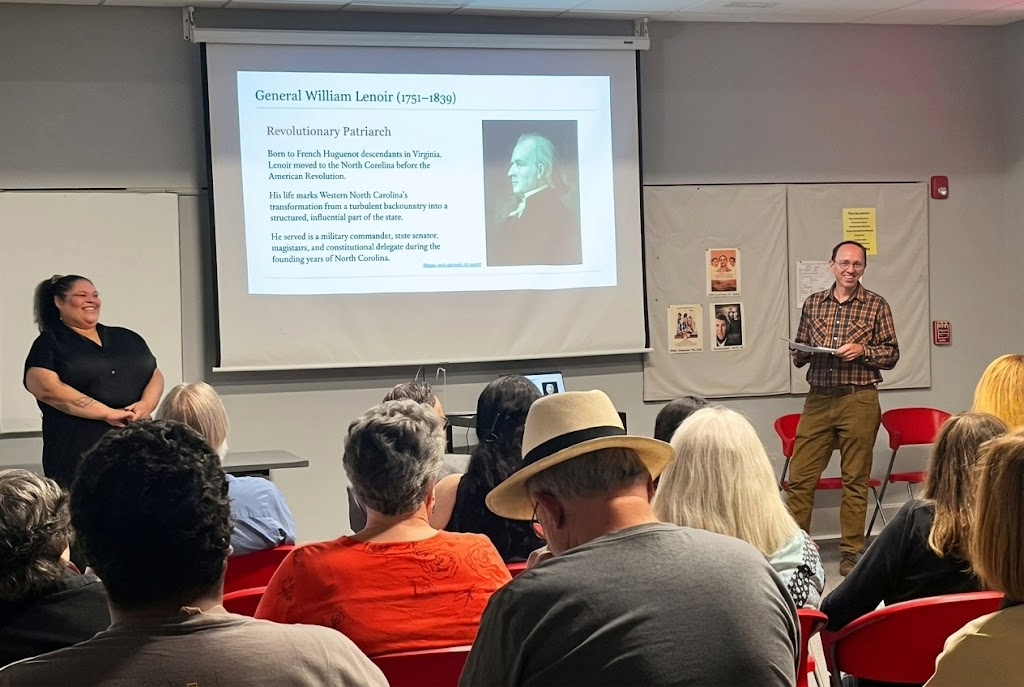
Much work by many members of the Special Collections department has already taken place around the Lenoir family papers. Before the collection was open to the public, Ross Cooper and Hannah Helmey, both of whom are a part of the Public Services team, were answering research questions about the collection. The collection was arranged and described by Manuscripts and Archives Processor, Celine Shay, who applied a meticulous amount of item-level description in her work. Together, Shay and I presented a joint talk about the collection to the Watauga County Historical Society. Curator for Distinctive Collections, Emily Kader, has collaborated with Public History faculty to integrate collection materials into the curriculum.
While the collection has been fully processed and opened to the public, there is still work to be done, digitization is next on the horizon. Scanning of the more fragile materials will happen in-house thanks to the Digitization & Digital Preservation team. The remainder of the scanning will be outsourced to a local company with whom Special Collections has a longstanding relationship. Digitization of the Lenoir family papers is generously made possible by Ike Forester and University Libraries Advisory Council member Barbara Freiman.
Anyone who wants to view this or other archival collection materials should make an appointment by going to the Special Collections Research Center’s website. For more information, please contact the Special Collections Research Center at 828-262-4041 or spcoll@appstate.edu.
– Contributed by Mark Coltrain, Oral Historian